

Injecting Registered Capital into a WFOE: Capital Account, FX Rules and How the Money Can Be Used
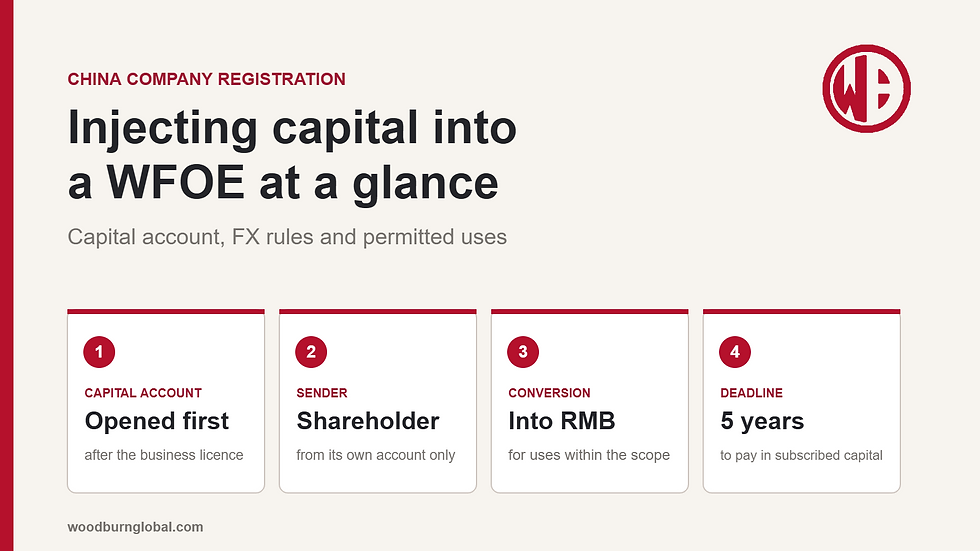
Quick answer: A foreign shareholder injects registered capital by sending funds from its own account to the WFOE's foreign currency capital account at a Chinese bank. The funds can then be converted into RMB and used for genuine business within the company's scope. Under the 2024 Company Law, the full subscribed capital must be paid in within five years of incorporation, and paid-in capital must be disclosed publicly.
Last updated: November 2026
Deciding how much capital to register is one decision, covered in how to calibrate registered capital. Getting the money into China and using it correctly is another. Mistakes at this stage, such as funds sent from the wrong account or spent on the wrong things, can delay the bank or cause problems at audit.
This guide to injecting registered capital into a WFOE walks through the capital account, how to send the funds, the foreign exchange rules on converting and using them, and the five-year deadline.
Step 1: Open the Capital Account
After the business licence is issued, the WFOE opens a basic RMB account for daily operations and a foreign currency capital account to receive capital. The bank also registers the foreign direct investment under the foreign exchange rules, a task banks now carry out on behalf of the State Administration of Foreign Exchange. Opening the accounts often takes longest, as explained in why bank account opening is the longest step.
Step 2: Send the Funds Correctly
When the shareholder sends the capital, make sure it goes:
From the shareholder's own account. If the shareholder is a company, the money must come from that company, not from a director or another group company.
In a currency allowed under the articles of association, usually a major foreign currency or cross-border RMB.
With a clear payment reference, for example "capital contribution to [WFOE name]".
In one payment or several, in line with the schedule in the articles of association.
Exchange rate movements can mean a foreign currency payment does not exactly match registered capital stated in RMB. Discuss the currency of registration with your adviser before filing.
Step 3: Convert and Use the Capital
A WFOE can generally convert its capital into RMB when it needs to and use it for genuine business purposes within its business scope. Typical uses are rent, salaries, equipment and supplier payments.
Capital account funds must not be used for:
Expenses outside the business scope or prohibited by law.
Securities investment or wealth management products, unless the rules allow it.
Loans to unrelated companies, unless the business scope allows it.
Buying or building property that is not for the company's own use.
Banks check supporting documents, such as contracts and invoices, before releasing larger payments from capital funds.
Step 4: Record and Disclose
Paid-in capital must be recorded in the accounts and disclosed publicly on the National Enterprise Credit Information Publicity System. The annual report and the audit will also show the capital paid. A separate capital verification report is no longer generally required, but the bank records must clearly show the contribution. Our China cloud accounting team records it correctly from day one.
The Five-Year Deadline
Under the 2024 Company Law, the shareholders of a limited liability company must pay in their subscribed capital within five years of incorporation. Companies set up before July 2024 with longer schedules must bring them within the limit during a transition period, with all capital paid in by 30 June 2032 at the latest. If the subscribed amount is more than the business needs, consider a capital reduction. Read more in your WFOE's five-year capital contribution clock.
Capital or a Shareholder Loan?
Some groups fund a WFOE partly through a shareholder loan instead of capital. Loans must be registered and are subject to borrowing limits, but they can be repaid more easily than capital can be returned. See China foreign shareholder loans.
Injecting Registered Capital at a Glance
Here is each step and what to watch out for.
Step | What to do | Watch out for |
Open the capital account | Open a foreign currency capital account after the business licence | The bank registers the investment, so documents must match the licence |
Send the funds | Pay from the shareholder's own account with a clear reference | Payments from a director or another group company may not count |
Convert into RMB | Convert when needed for business within the scope | Banks ask for contracts and invoices before larger payments |
Use the capital | Pay rent, salaries, equipment and suppliers | No unrelated loans, speculative investments or non-own-use property |
Record and disclose | Book the contribution and publish paid-in capital | The audit and annual report must show the same figures |
Meet the deadline | Pay in full within five years of incorporation | Older companies must adjust their schedules by the transition deadline |
Setting up a new WFOE? Our China company registration team guides the bank set-up and the capital injection, and our guide to setting up a company in Shanghai shows where this step fits.
Frequently Asked Questions
How long does a WFOE have to pay in its registered capital?
Five years from incorporation under the 2024 Company Law. Companies set up before July 2024 with longer schedules must bring them within the limit, with all capital paid in by 30 June 2032 at the latest.
Does a WFOE still need a capital verification report?
Generally no. The bank's records of the capital account and the company's accounts show the contribution, and paid-in capital is disclosed on the National Enterprise Credit Information Publicity System.
Can capital be contributed in kind?
Yes. Capital can be contributed in assets such as equipment, intellectual property or equity in another company, which must be valued and legally transferred to the company.
What if the shareholder pays from the wrong account?
The bank may refuse or return the funds, and the payment may not count as a capital contribution. Check the payment instructions with your adviser before sending.
Can we use capital to pay the parent company for services?
Possibly, if the services are genuine, documented and within the business scope. Banks and tax bureaus look closely at these payments, so keep contracts and evidence of the work.
Related Reading
Get your capital into China, and used correctly We guide the bank set-up and injection, record the contribution properly and make sure the funds are used in a way that passes audit. Book your free 30-minute consultation → Or call Shanghai +86 21 5116 2893 · Hong Kong +852 3978 0300 |
About Woodburn Accountants & Advisors
Woodburn Accountants & Advisors helps international businesses set up and run companies in mainland China and Hong Kong. With more than 30 years' experience and offices in Shanghai and Hong Kong, our team of chartered company secretaries, certified public accountants and tax specialists has guided hundreds of foreign companies, from first-time market entrants to established multinationals, through company registration, accounting, tax, payroll and annual compliance. We combine large-firm expertise with boutique responsiveness.
Our China services: China Company Registration · Cloud Accounting & Financial Reporting · Cloud Payroll · Tax & Audit · Employer of Record · Finance Manager · Visa Applications · Trademark Registration
Already have a company in China or Hong Kong? Switch to Woodburn free of charge.
Shanghai: 47/F Hong Kong New World Tower, 300 Huaihai Zhong Road · Hong Kong: 16/F One Island South, 2 Heung Yip Road, Wong Chuk Hang · Hong Kong TCSP Licence TC002595 · Employment Agency Licence 71160


